
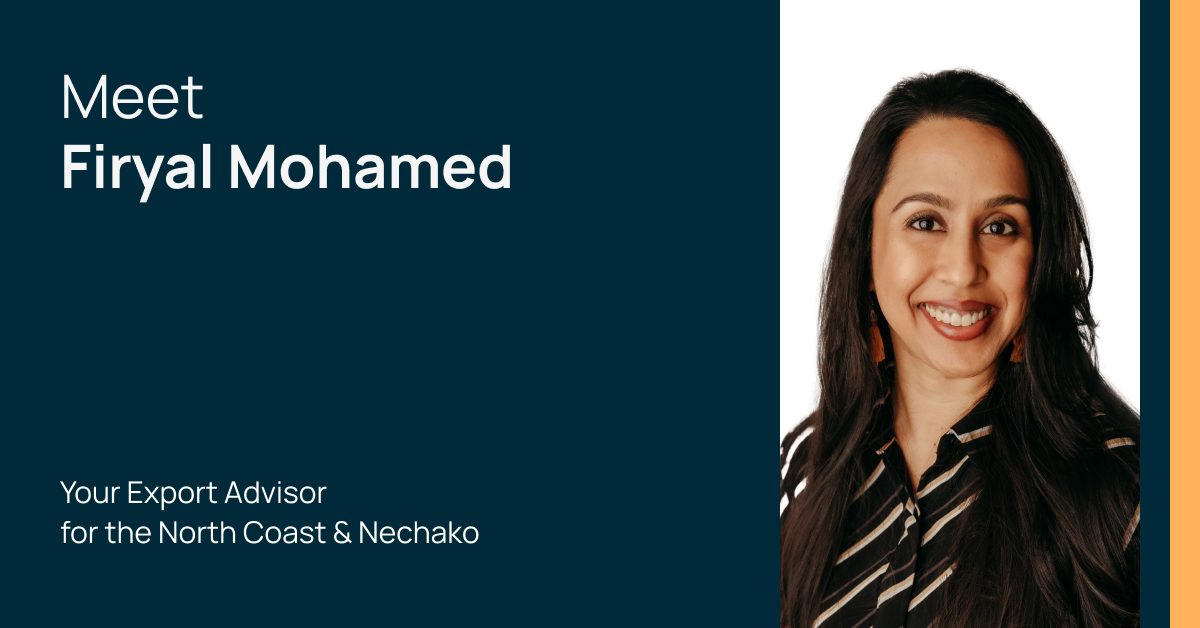
 Based in Hazelton on the traditional territories of the Gitxsan First Nation, Firyal Mohamed helps northern entrepreneurs reach new markets and grow their businesses beyond B.C. with confidence. She supports businesses across B.C.’s North Coast and Nechako regions as an Export Advisor.
What kinds of businesses do you mainly work with?
I work mostly with solo entrepreneurs, and small, family-run businesses, although Export Navigator supports small and medium-sized businesses of all sizes. Across the Pacific Northwest, I work with a vibrant range of Indigenous and non-Indigenous businesses—agrifood producers, wellness and skincare brands, artisans, microbreweries, and jewelry makers and distributors, to name a few. It’s a diverse mix, which keeps the work interesting and grounded in what’s happening in our communities.
What is your professional background, and how did it prepare you to work as an Export Advisor?
I’m a community economic developer by education and experience. My work has always focused on building economies from the ground up; connecting broader economic goals with real benefits for local communities.
Over the years, I’ve worked in business development, grant writing, strategic planning, food security, and with non-profits focused on agriculture, arts, health and education. Believe it or not, I was once a chicken farmer! I came to Hazelton to advise on and develop a unique business model for a poultry operation designed to test whether a locally rooted food system could meet the region’s needs. All that experience helps me understand the realities businesses face, especially in rural and remote communities.
What do you look for in a business to determine if they are ready to grow beyond B.C.?
There are practical things we look at, like operations, staffing and whether the business can handle the increased demand. But in the North, readiness can look different.
I also look for commitment and grit. Growth isn’t always quick or easy, and businesses need to be prepared to work through added barriers like distance, logistics and infrastructure challenges that come with living in the North.
If a business is already selling across regions, moving goods by ferry or over long distances, that’s often a strong indicator they’re ready to think bigger. All of sudden, stepping into another province doesn’t seem like a leap anymore. It starts to feel like the natural next step.
What are some early steps a business can take to become export-ready?
Honestly, the early steps can be quite simple. Start small. That might mean spending some time researching markets you’re curious about, getting a feel for the type of buyer who might be interested in what you offer, and reading up on what’s happening in your industry. You don’t need all the details right away—just building that early awareness makes a big difference.
I also encourage businesses to lean into local connections. One advantage of northern communities is access. You can often connect easily with people who have valuable knowledge and experience, right in your community.
Using free supports like Export Navigator early on is another great first step. It gives businesses a no‑pressure space to explore possibilities, ask questions and figure out what growth could look like before making any big commitments.
Why should a business work with an Export Advisor?
One of the biggest benefits is that I live in the region I work in. I understand the realities of doing business in the North because I experience them too. That perspective really shapes the way I support clients—especially those who grow weary of the ‘helicopter-support’ that rural communities often must rely on. Every business has assets they’re already bringing to the table, and my role is to help surface those strengths and then figure out what additional support or resources can help them grow.
How would you describe your advising style or approach?
I’d describe it as practical and personal. There’s no cookie-cutter approach. I take time to understand the business, the person behind it and the environment they’re operating in so I can offer advice that fits.
Businesses come in as the experts in what they do—but it’s the other pieces, like hiring, marketing or planning for growth, that can get overwhelming. That’s where we come in. If I understand where a business is today and where they’d like to be, then my job is to identify and connect them to the supports and resources they need, when they’ll have the most impact for the business.
What’s your best advice for aspiring entrepreneurs?
We live in a part of the province that’s proudly off the beaten path! People here genuinely love where the live, and they care deeply about the wellbeing of the whole community. Living rurally often means making things work despite limitations, and that resourcefulness has real strength. The North is innovative in a practical, no‑nonsense kind of way—and that has tremendous value.
When small businesses grow, the whole community grows with them. Expansion brings jobs, investment and stability. Reaching new markets doesn’t take anything away from a community. If anything, it strengthens it. People want to experience a piece of the North. So, get out there and share it with them!
Get in touch
Export Navigator offers free, one-on-one support to help B.C. businesses explore new markets and grow with confidence. Reach out today to learn more.