How Tariffs Impact International Trade

Note: This post was updated in April 2025 to reflect the changing tariff environment in Canada.

It’s difficult to imagine a world without imported goods. Many of us wake in the morning on an imported bed, drink imported coffee and drive to work in an imported car. International trade is foundational to our everyday lives.

As a business owner, contributing to the global market is an exciting idea, yet exporting isn’t as simple as sending a shipment over the border. Governments worldwide implement policies and rules that influence global trade, such as tariffs. Also known as duties, tariffs are the fees levied on goods transported from one country to another.

Tariffs are established to help protect the domestic market, both directly and indirectly.

For example, an international company and a British Columbian (B.C.) business might sell clay coffee mugs for $30 a piece. The international company must pay a 10% tariff when importing their mugs to Canadian markets, increasing the price to $33. Unimpacted by tariffs, the B.C. mugs remain at $30.

The coffee mug company in B.C. benefits from this tariff, as it helps make their product more competitive and consumers might be more likely to purchase their mugs.

That said, when the tables are turned, tariffs can become a challenge in the exporting process. If the B.C. company exports to a country that imposes tariffs on Canadian coffee mugs, then the price of their product increases. This can make it more difficult to compete in the international market.

Tariffs and Trade in 2025

Trade tensions continue to shape Canada’s relationships with key global markets. The news changes quickly and there is a lot of stay on top of. Currently:

  • United States. While the Canada-United States-Mexico Agreement (CUSMA) remains in force, trade friction has increased due to renewed U.S tariffs on specific Canadian-made steel and aluminum products, as well as emerging disputes over agricultural exports such as dairy and softwood lumber.
  • China. Canada’s trade relationships with China remains strained, with tariff and non-tariff barriers affecting exports such as canola and pork, Canada has diversified export markets in response but continues to face challenges accessing Chinese markets.
  • European Union. Although CETA provides preferential access to EU markets, Canada has raised concerns about regulatory barriers and tariffs being applied in ways that limit access for certain goods, particularly in the agricultural and food sectors. Despite these issues, there is more interest in increasing trade between Canada and the EU due to the ongoing trade issues from the U.S.

Understanding Tariffs

Just as goods and services come in many shapes and sizes, there are a range of different types of tariffs to be aware of.

The example above is an ad valorem tariff, a Latin term translating to ‘according to value’. This type of tariff is calculated as a percentage of the item’s overall cost (10% in the example above).

Specific tariffs, on the other hand, are fixed price, meaning that regardless of the value of the imported good or service, the tariff remains the same. In the scenario above, Canada might place a $5 tariff on all imported coffee mugs, bringing the imported mug to $35.

Countries may also impose export quotas on specific goods or services to further protect their domestic market. For example, if Canada began exporting too many coffee mugs, the federal government may limit the number of mugs that can be sold internationally to ensure Canadians aren’t faced with a coffee mug shortage.

Some goods and services also have a surcharge or surtax associated with them, which is an extra tax or duty in addition to the current tariff. Surcharges are designed to further safeguard the domestic market.

Types of Trade Agreements

Needless to say, tariffs have their benefits, but they can complicate international exporting processes.

Around the world, governments form trade agreements that can reduce or remove tariffs and help streamline and simplify trade.

Canada participates in a range of agreements with other countries worldwide:

Plurilateral and multilateral agreements are made between a small number of countries who have a shared interest in a good or service. For example, Canada and 22 other countries are part of the Trade in Services Agreement, designed to improve market access telecommunications, express delivery and many other services.

Free trade agreements greatly reduce or remove tariffs and other trade barriers for participating countries. Free trade agreements simplify access to a wider range of export and international investment opportunities for Canadian businesses.

Navigating Tariffs in Your Business

As you begin to develop your export plan, there are a few steps you can take to help navigate tariffs in international trade:

1. Leverage Canada’s Free Trade Agreements

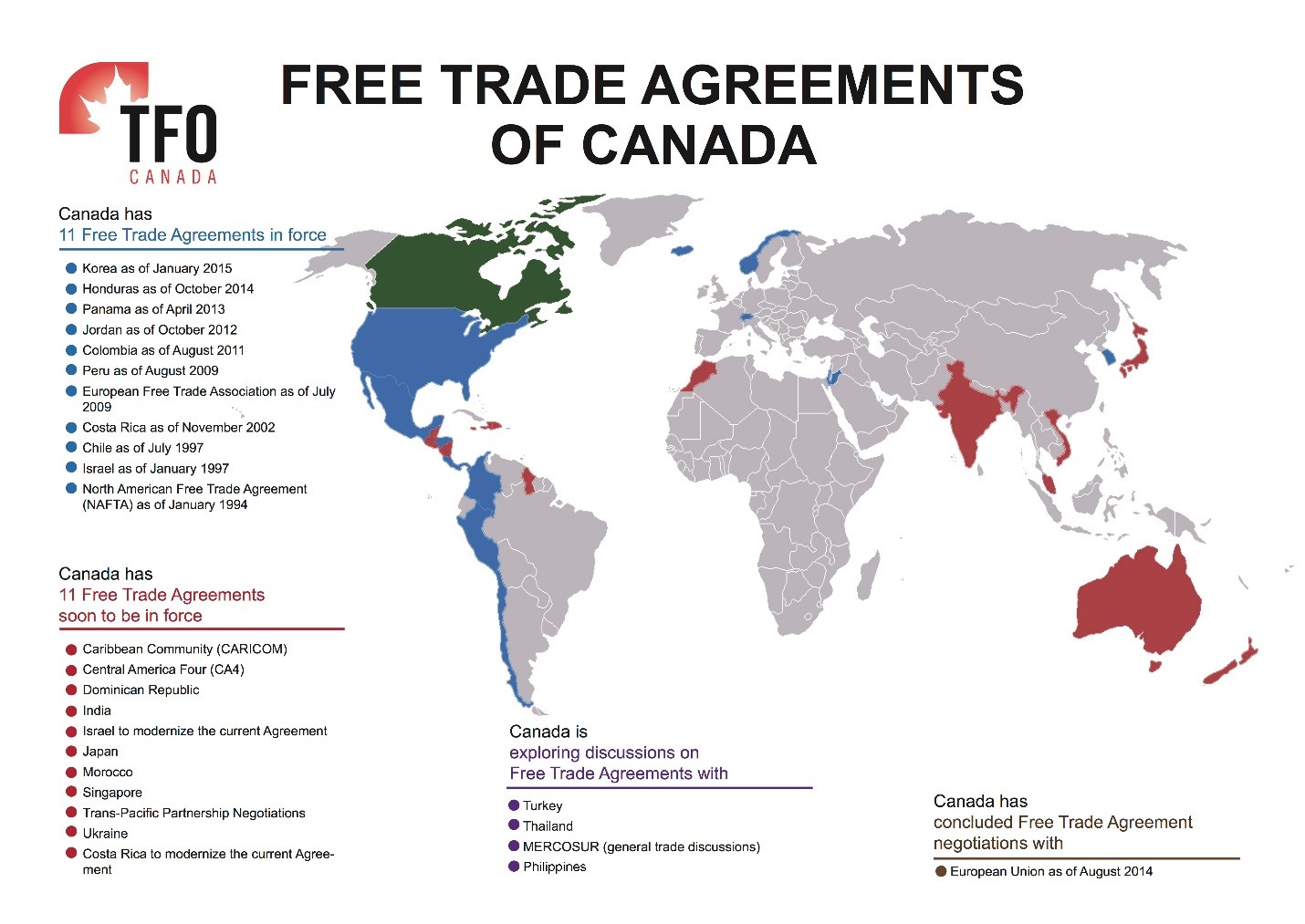
Through researching free trade agreements, you can learn more about how to export to participating countries without facing tariffs or duties. Canada currently participates in 15 free trade agreements with 51 different countries, opening the market to 1.5 billion consumers worldwide. For example:

In addition to considering how free trade agreements help to reduce your costs as an exporter, you may be able to source key supplies for your business from markets that participate in a free trade agreement with Canada, reducing your operating costs.

2. Use the Canada Tariff Finder

The Canada Tariff Finder is designed to help businesses understand the tariffs that apply to their specific goods and services. Simply input the importing and exporting country and search keywords pertaining to your goods or service to take the guesswork out of estimating tariffs.

3. Explore Domestic Suppliers

When sourcing supplies for your business, consider how tariffs on imported goods might be increasing your operational fees. By forming relationships with local businesses, you may be able to purchase supplies at a lower price.

If your supplies can’t be sourced locally, try to make free trade agreements work for your business. You may be able to purchase the items you need from markets that participate in a free trade agreement with Canada, avoiding the increased prices associated with other imported products.

Get Support Today 

Free trade agreements and online tools exist to help streamline and simplify international trade. Still, the process of understanding how tariffs and other trade barriers impact your business can feel overwhelming. Don’t be discouraged – Export Navigator is here to help! 

Our experienced team of Export Advisors is available to answer your questions and help you better understand how to take your business beyond B.C. Reach out today to learn more. 

Marketing Your Products to a Global Audience

Marketing Your Products Globally

In today’s world, global is the new local. It’s easier than ever for businesses of all sizes to market their products to an international audience. But while launching a new product is never easy, expanding to new markets is a unique challenge. You’ll need to answer a few key questions before marketing products globally. What types of products does your target market want? How will your product meet their needs? Which channels and messaging will resonate with your new target customers? Answering these questions will put you on the path to international marketing success.

Stage 1: Research

First, you need to understand the local market by undertaking market research. It can be tempting to proceed without market research, but this is a fundamental step you should not miss. Research will give you answers to several important questions:

  • What are the needs of your target audience?
  • What are their interests and preferences?
  • How do local customs and traditions affect purchase behaviour?
  • What marketing channels do they prefer?
  • What motivates them to buy a product?
  • At what price are they willing to buy the product?
  • What is your USP over local competitors?

Once you have answered these questions, you can start preparing your product for new markets.

Stage 2: Localization

It’s essential to ensure you account for local differences before launching into a new market.

Your Product

It might not make sense to sell the same product in different countries. You might pursue three strategies when looking to sell products in new markets. The first is product extension, which refers to selling your current products without changes. Extension can work well if your new market is similar to your local audience. If the new market has specific attitudes or preferences, you might instead choose product adaptation. Adaptation means modifying your product to fit local needs. For example, you might change the spicing in your sauce to suit the tastes of a different country. The last strategy to consider is product invention, when you create a brand new product for the market in question. The research you completed earlier will give you insight into what product strategy best fits your new audience.

Regulatory

Beyond ensuring you have the right product-market fit, your product must meet the rules and guidelines for a new country. You might need licenses or permits to sell certain types of products. Or, your product might require more detailed labelling to fit a different country’s regulations. You can find this information on the Government of Canada’s Country and Sector Information resource.

Language 

Finally, if you plan to sell your products in different countries, you may also need to consider language differences. Perhaps the most visible place to update language is your product’s labels and packaging. If you plan to translate your current labels, hire a native speaker or professional translator to do the translation. Plus, remember to check any symbols and imagery for social context. Finally, you might also need to account for customer service in a different language. Set up a website and phone number with service in this language so customers can receive help and find answers to their questions.

Stage 3: Execution

Once your product is ready, you’ll choose where, when, and how to market in a new country. Be prepared to re-learn best practices when marketing overseas.

Channels

Carefully consider the marketing channels you select for a new audience. Some countries may prefer traditional marketing (magazines and billboards) over digital (social media and email). Your initial research should give you an idea of what channels your audience prefers. Make sure to keep an eye on the number and visibility of your advertisements. Consumers in some countries might be used to seeing advertisements in different formats at high frequency. But, consumers in another country may find too many messages to be off-putting.

Messaging

Precise, simple messaging reads well in any language. Focus on clarity and simplicity when designing marketing plans to be translated. Phrasing without slang or jargon will be more straightforward to translate – you can always add regional flair later in the process. Learning the values of the cultures you want to communicate with will allow you to create messaging that resonates and doesn’t offend.

Measuring 

Measuring and reporting on your efforts is a critical part of evaluating the success of your new international strategy. When you track valuable metrics, you will gain insight into what tactics work best and be able to maximize your marketing efforts. Metrics you’ll want to track might include conversions, cost per acquisition (CPA), return on advertising spend (ROAS), click-through rate (CTR), and engagement rate. You can find these figures in your website analytics and paid advertising dashboards.

Start Marketing Globally

While expanding your products to new markets can be exciting, it can also be complex and intimidating. Marketing products for a global audience will require a lot of research if you still need to become familiar with your target country.

At Export Navigator, our Export Advisors can help save you time and effort in marketing your products internationally. Find an advisor today and discover what opportunities are available to you.

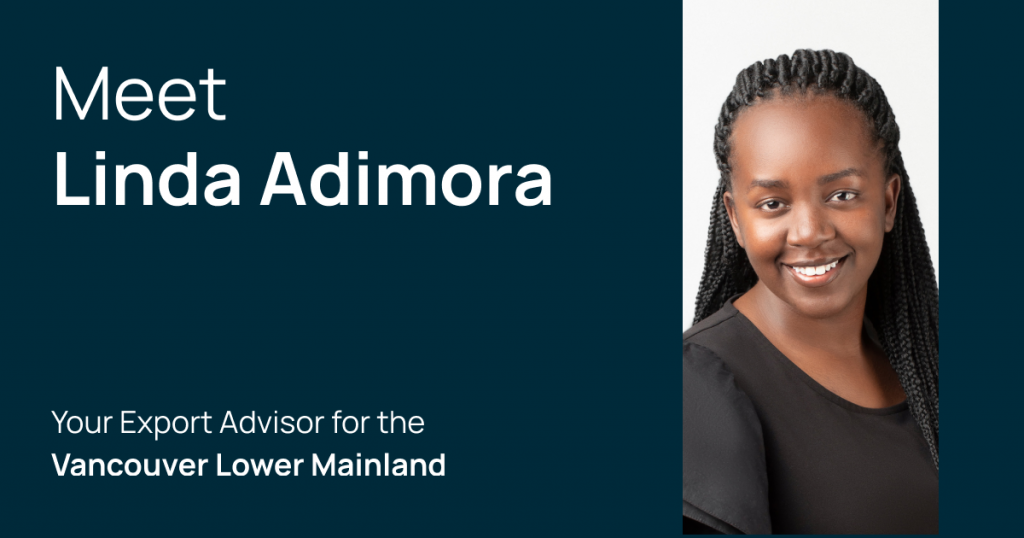
Meet Linda Adimora: Export Advisor for the Lower Mainland

As an Export Advisor, Linda Adimora draws from her corporate and entrepreneurial background to support businesses looking to export. With personal experience in importing and exporting, she knows the importance of venturing beyond local markets. Her best advice? Build a strong support system and get ready to face your biggest challenges head-on.

Export Navigator: Can you introduce yourself and what you do in your role as an Export Advisor?

Linda: My name is Linda Adimora, and I’m an Export Advisor for the Lower Mainland, covering Surrey, Langley, White Rock, and the Fraser Valley. In my role, I’m responsible for supporting businesses that are looking to grow their markets. Part of that role means being there as needed to provide support, value, and information on any opportunities that would help a business meet its export goals. Essentially, I am here to support businesses in all areas of their growth.

Export Navigator: What is your professional background, and how did that prepare you to work as an export advisor?

Linda: I have both a corporate and entrepreneurial background. I worked in e-commerce, marketing, construction, and manufacturing in my corporate career. From establishing global distribution for Canadian-made construction equipment, I then moved into entrepreneurship, which includes running my own brick-and-mortar store in Downtown Chilliwack and establishing export markets with major retailers in the US. My diverse background has served as a strong foundation for this advisory role because I also understand first-hand the pain points business owners feel when wanting to grow and reach new markets. My experience allows me to advocate for opportunities that might not be easily accessible, and to make the journey of growing and scaling a business simpler and more efficient, one business at a time.

Export Navigator: What do you look for in a business to determine if they are ready to grow beyond B.C.?

Linda: Beyond product or service validation, the entrepreneurial mindset is key. Exporting requires a lot of commitment of various resources, including time. Second, entrepreneurs can’t ignore finances. Exporting can be a costly growth strategy. How much risk is a business willing to take to drive growth? I find that for many businesses, it’s beneficial to grow locally and interprovincially first before exporting internationally.

Export Navigator: How would you describe your advising style/approach to working with clients?

Linda: I take a supportive approach but am also honest and direct. Good advice is clear and trustworthy, even if sometimes it’s different from what you might want to hear. Plus, I try to always leave clients with something to take away. Along with that, I have an open-door policy. My clients can reach out to me anytime, and I’ll be there to champion their work as much as possible. Finally, I see myself as a connector. If there is ever anyone or anything in my network that can help, I extend that to my clients. With exporting, so many parts of the business can be involved, from marketing to production and everything in between. For that reason, I see myself as a champion for the business as a whole, not just the exporting side.

Export Navigator: Aside from being an Export Advisor, what else do you like to do in your free time?

Linda: It’s hard to choose which hobbies to mention! I love hosting. Food is a core piece of me because it’s an extension of my love for travel. I enjoy experiencing different culinary flavours, recreating them, or making dishes from countries I’ve never visited. My favourite food to make is probably our staple food from Zimbabwe, comprised of a stew and a cornmeal-style side similar to polenta, which you eat with your hands. It always makes for a good ice-breaker!

I also recently picked up golf, so I enjoy being on the range, challenging myself with something new. And, of course, family time is essential. It’s special for me to be with my family and create moments to look back on, so I’m very proactive about spending time with loved ones.

Export Navigator: What’s your best advice for aspiring entrepreneurs?

Linda: Eat your frogs! What I mean is, do the difficult things first. The big steps, especially the difficult ones, are usually the steps that will move a person or a business forward. For example, getting product certifications can be difficult but critical. I’d recommend that entrepreneurs address areas they don’t naturally enjoy. This might include having to outsource, hire, or seek mentorship opportunities.

Learn more

Thinking of exporting? Find an advisor today and discover what opportunities are available to you.

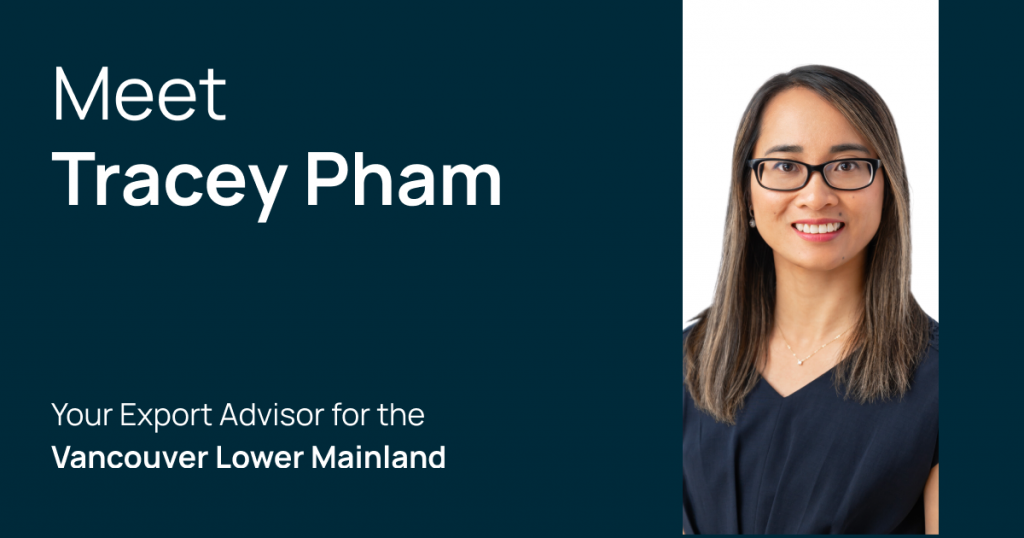
Meet Tracey Pham: Export Advisor for the Lower Mainland

With multinational experience ranging from Singapore to West Africa to the Fraser Valley, Tracey Pham knows a lot about international markets. Now serving the Lower Mainland as an Export Advisor, she brings a wealth of global expertise to her growth-minded clients.

Export Navigator: Can you introduce yourself and your role as an Export Advisor?

Tracey: I’m Tracey, the Export Advisor for the Lower Mainland, serving Vancouver, Richmond, and Delta. I support businesses of various sizes and stages. The majority of my clients are established in B.C. and ready to expand, whether interprovincially or into new countries. I also work with a few pre-revenue companies with strong potential, as well as several businesses that are exporting already. My clients also vary in industry and number of employees. It’s exciting to be able to support a wide range of businesses that are at different stages of their exporting journey.

Export Navigator: What is your professional background, and how did that prepare you to work as an Export Advisor?

Tracey: I started my career in a multinational company in Singapore. In that role, I worked on developing and marketing products in other Southeast Asian countries, mainly Thailand, Vietnam, and the Philippines. That gave me a lot of knowledge about labelling, regulatory compliance, and understanding consumer differences and consumer preferences in different markets. After that, I worked for another multinational company in West Africa, where again I focused on ensuring that products meet consumer needs and are marketed effectively in a West African context.

I moved to Canada in 2014 and did my MBA at UBC. In my last role, I worked with a pet food company based in the Fraser Valley, where I was the head of international marketing. While working there, I supported the company’s expansion to over 35 countries around the world. I learned how to leverage government support and government resources like Export Development Canada and the Trade Commissioner Service. Now, as an Export Advisor, I can help my clients because I understand the international landscape, regulatory compliance, and different market requirements. That makes me a good fit to advise companies looking to expand and grow outside B.C.

Export Navigator: What do you look for in a business to determine if they are ready to grow beyond B.C.?

Tracey: The first time I talk to a business, I look for readiness in a few different areas. The first is the readiness of the company’s founder or CEO. That also includes the personal readiness of the core team leading the business. The second is the readiness of the company itself. To be ready to embark on this journey, I look for a growth mindset, that the company is prepared to navigate growth and the challenges that come with it. The third and final area is the readiness of the product. I look at whether the product has appeal outside of B.C. and if it has the potential to grow. We also examine whether the product or service can be customized and scaled for different markets. I’d say those are the three main criteria of successful exporters: personal readiness, company readiness, and product or service readiness.

Export Navigator: How would you describe your advising style/approach to working with clients?

Tracey: I ask a lot of questions. For me, it’s critical to understand what the founder and CEO’s vision is. To get there, I ask quite a few questions, starting with the business and why they started, but also what gets them up in the morning. What are they trying to achieve? Sometimes, they’ll need to tap into those reasons when things don’t go right. The founder and the core team need to understand why they’re doing this so they can make the right decision at every step of the way. Answering these questions helps to crystallize the vision for the business. Then, we’ll move from high-level to much more detailed questions, like what shipping provider they’re using and if any challenges arise from that.

Through this questioning process, sometimes we find that the original issue they came to me with is just the issue on the surface. When we get in-depth, we uncover many things the business owner may have yet to consider. When I understand the business and the founder, I can provide more holistic advice and elevate the conversation rather than just answering the questions they come with.

Export Navigator: Is there a type of business or client you find benefits the most from the program?

Tracey: I believe that most businesses we work with will benefit from the program in one way or another. When a business is ready to take the first step in exporting,we provide a lot of value because the business is ready to receive our service, and we can give them the help they’re looking for. But even businesses that are quite small or pre-revenue have the potential to scale quickly, especially in technology-focused industries. For businesses already exporting and looking to expand, we can help by connecting them with resources to consider and validate other opportunities.

Export Navigator: Aside from being an export advisor, what else do you like to do in your free time?

Tracey: I have two dogs, so I spend a lot of time with them. Most weekends, we are outside hiking. In the summer, we go camping. They love snow, so we go snowshoeing in the winter. I also love snowboarding, so I spend a lot of time outside. Why not, when we live in B.C., one of the most beautiful places on earth?

Export Navigator: What’s your best advice for aspiring entrepreneurs?

Tracey: I would say tap into as many resources as possible. A business owner often does ten jobs at once, and it can be difficult to pause and look at the available support and resources around you. In B.C. specifically, there is a robust ecosystem that supports entrepreneurs. Whichever industry you’re in, there will be some type of entrepreneurial support. I’d recommend taking advantage of those resources as much as possible because, you never know, you might be able to get a grant or some funding. Or, you might be able to receive mentorship or advice from people who have been where you are, which can make the journey a little bit easier. Being an entrepreneur is difficult, but with the proper support, you might be able to accelerate the process.

Learn more

Thinking of exporting? Find an advisor today and discover what opportunities are available to you.

Meet Jason Seed: Export Advisor for Victoria

Every business owner’s success story is shared by those who have supported them along the way. For Jason Seed, export advisor for Victoria, one of his favourite things about working with clients is sharing their success. And he believes that no business is too small to celebrate. Whether a company is developing green technology in a warehouse or bottling sauce in a home kitchen, Jason is here to help share unique Victoria businesses with the world.

Export Navigator: Can you introduce yourself and your role as an export advisor?

Jason: I’m Jason Seed, the export advisor for the Victoria region. My central role is to help businesses grow either inter-provincially or internationally. I also see myself acting as a connector, making sure that the companies I work with know about the grants and services that are available to them. Since the Export Navigator program started as a rural initiative, we believed businesses in Victoria and other urban centres would already have a good handle on the available funding sources, government programs, and third-party business services that are out there. I’ve discovered that most companies need to be made aware of many of the initiatives that could help grow their business. So, I enjoy being able to connect businesses with the right resources. Of course, I also offer business advisory services, market planning, market entry and market research to businesses of all sizes.

Export Navigator: What kinds of businesses do you mainly work with?

Jason: I work with a nice selection of life science companies and several companies working on clean technology or general information technology. I have a pretty good roster of agri-food companies as well. One category that surprised me was manufacturing. I was surprised to see all of the manufacturing going on in the Victoria area.

Export Navigator: What is your professional background, and what made you want to work as an export advisor?

Jason: I’ve done a lot of consulting over the years with agri-tech companies and tech companies in general, but the companies I work with here are quite a bit different from anything I’ve worked with in the past.

After building several successful companies across Canada and having kids at home, the travel got too difficult. I have always loved consulting, so when I saw the export advisor opening, I saw it as an opportunity to help businesses closer to home.

Export Navigator: What do you look for in a business to determine if they are ready to grow beyond B.C.?

Jason: I’d say only about a third of my clients fit into the category of companies that have yet to even think about exporting beyond B.C. In contrast, the rest of my clients are already exporting but need help with new markets or grants and funding, for example. When meeting new clients, I look closely for a sense of initiative or drive. I find that the most successful clients are communicative and responsive, and we end up having many back-and-forth conversations. The most eager clients are those who find success quite quickly. I respond well to energy and enthusiasm, so I enjoy working with companies that are excited as well.

Export Navigator: How would you describe your advising style/approach to working with clients?

Jason: I think of myself as a go-getter and advocate for my clients. I think it’s also essential to build awareness, especially among all the government agencies here. I prioritize getting the proper attention for clients ready to expand their business. But I’m not an expert on every program; if I don’t have the answer, I’ll find it for them. In many cases, that happens because I’m dealing with sectors and businesses I haven’t encountered before. But I’m quickly expanding my knowledge base and learning lots of new things along the way.

One other way I work is to connect clients with each other. I enjoy this greatly because I see what they’re doing and how they can benefit each other. I’ve had great feedback so far from clients that I’ve connected with other clients.

Export Navigator: Aside from being an export advisor, what else do you like to do in your free time?

Jason: I love to spend time with my kids. I promised my kids when they were young that whatever they were interested in, we would explore together. My daughter loves science, so we read Smithsonian encyclopedias about planets and the universe, dinosaurs, plants, rocks, and everything in between. My son also loves dinosaurs, especially ancient sea creatures; the meaner, the better.

Export Navigator: What’s your best advice for aspiring entrepreneurs?

Jason: We live in an exciting time right now where if you cobble together all the different programs and services available to a business, there’s a clear path from a startup to a successful multinational company. In the past, that would have been unheard of. I’d want businesses to know that you have an export advisor on your side to work with you on every step. There’s essentially a program or service for every step of the way, which is phenomenal.

Learn more

Thinking of exporting? Find an advisor in your region today and discover what opportunities are available to you.

5 Ways Free Trade Agreements Make Exporting Easier

Free trade agreements are the unsung heroes of exporting. By definition, free trade agreements (or FTAs) are treaties between two or more nations that form free trade areas. What this translates to is the loosening of trade restrictions, reduction in costs, and greater opportunities for exporters. 

FTAs typically minimize a wide range of regulatory barriers. In this blog post, we’ll provide an overview of all the ways FTAs make exporting a smoother process.  

1. Get preferential access to new markets

Canadian companies can export more easily to over 50 countries around the world that have FTAs with Canada. One of the most coveted FTA benefits is the simplified operational procedures for entering foreign markets. It reduces the unpredictability and compliance issues that are common when exporting to new countries. 

2. Save money    

FTAs almost always lower the tariffs placed upon foreign products, making exporting abroad less costly. 

3. Overcome non-tariff barriers to trade 

Not only do FTAs lower or remove tariffs but they can also provide other benefits. These include higher import quotas, shorter border-processing delays, and Intellectual Property (IP) protection which shields exporters from fraud and copycats in their new markets. 

4. Increase transparency of foreign markets 

Foreign markets can be unpredictable, but FTAs can offer Canadian business owners peace of mind. They may emphasize adherence to responsible business practices and advocate for meeting global standards. For example, the Canada-European Union Comprehensive Economic and Trade Agreement (CETA) includes provisions for product standards, professional certification, as well as labour rights and environmental protection. 

5. Bid on procurement contracts 

Another way FTAs grant Canadian companies a competitive edge is when it comes time to bid on government contracts. Government procurement is when governments and other public bodies buy goods and services. Some FTAs allow all Canadian companies to bid on procurement contracts – CETA is one example of this, unlocking a market worth $2.6 trillion annually. Sometimes, FTAs even encourage investment in the foreign market. 

An Example of FTA Benefits in South Korea 

Here’s a quick illustrative example to see how free trade agreements benefit Canadian businesses. 

On March 11, 2014, the Government of Canada and the Republic of South Korea formally concluded the Canada-Korea Free Trade Agreement (CKFTA). It subsequently entered into force on January 1, 2015.

Let’s look at beef to start – a particularly contentious product for importing into South Korea. It also happens to be Canada’s fifth most important beef export destination

Pre-CKFTA, fresh or chilled boneless beef (HS Code: 0201.30.00.00) carried a 32% tariff. That means, before your shipment of steak was even allowed to clear customs in South Korea, you’d have to pay a 32% tax on the value of your shipment. This substantial fee made competition with local producers nearly impossible. 

CKFTA resulted in a massive reduction in these tariffs. As of 2022, this tariff has been reduced by nearly half – to 18.6%. By 2030, all Canadian beef imports to South Korea will be tariff-free. Countries without an FTA with South Korea are taxed a whopping 40% on beef exports today. This puts Canadian companies at an incredible competitive advantage in the South Korean market.

Upon full implementation, South Korea will have eliminated 98.2% of all tariff lines for Canadian goods.

Including South Korea, Canada has 15 FTAs with 51 different countries – the USA, the European Union, and a number of countries in the Asia-Pacific region. 

Fun fact: Canada is the only G7 country with free trade access to the entire G7 & European Union. 

Canada’s FTAs cover 61% of the world’s gross domestic product (GDP) and open up markets to 1.5 billion consumers worldwide. You can read more about Canada’s FTAs at Global Affairs Canada’s website here.

A great tool to see what tariffs you may face exporting to specific markets is Canada’s Tariff Finder. Here you can search for your product, identify your HS code (which is the code used to identify and classify traded products), and see which tariffs may apply upon export. You can also use the International Trade Centre’s Market Access Map.

Stay tuned for the rest of our Free Trade Agreement series, where we’ll touch on the benefits and specific considerations of:

  • CUSMA – the FTA between Canada and the US
  • CETA – the FTA between Canada and the European Union
  • CKFTA – the FTA between Canada and South Korea; and
  • CPTPP – the FTA between Canada and ten countries in the Asia-Pacific 

Get Export Support Today

While FTAs open many doors for exporting to new countries, they can also be difficult to understand. These dense documents filled with legal jargon and complicated language require a lot of research if you are not already familiar with FTAs. 

At Export Navigator, our experienced Export Advisors can help save you time and effort in deciphering FTAs. Connect with an advisor today to learn how to take advantage of FTAs for your business, and get answers to your export-related questions. 

Why You Should Attend Trade Shows

Trade shows can open new doors when it comes to growing your business. Whether your goal is to research potential new markets or to size up your competition, trade shows are a one-stop shop for improving your export plan. 

By attending trade shows, you will get the opportunity to:

  • Gain market intelligence
  • Network
  • Test your products
  • Scout out the competition
  • Expand your sales on a large scale 

While being an exhibitor at a trade show comes with its own advantages, it can be costly. Simply walking a trade show is a low stakes way to test the waters and see if you’d want to exhibit there in the future. One way to make the most of attending is to conduct primary research and gain insight into consumer behaviors in another target market. 

From Attendee to Exhibitor

Unlike attending a show where you get to just be a fly on the wall, exhibiting requires a much higher level of commitment. However, the benefits are worth it. Becoming an exhibitor at the right trade show attracts attention and can elevate your legitimacy as a business. It indicates that your business features a notable product or service to showcase. As trade shows are highly interactive events, other benefits of exhibiting include gaining feedback, and opportunities to lock down sales. You can also host meetings with other companies, vendors, and agents in the market – all of whom will be valuable assets in your export journey.

A question you might have is how to choose the right trade show to exhibit at. Taking into account the costs involved, you want to make sure your return on investment (ROI) exceeds what you invest. A common rule of thumb is to decide on your trade show objectives and strategy before even researching where to exhibit. There are many things you can accomplish at a trade show, but a focus area can help you save time. For example, maybe your main goal is finding customers and raising awareness of your company. Then, you’d want to allocate more resources towards marketing and networking. If your focus is on launching a new product or service, you might consider having samples or demonstrations at your booth. 

Don’t forget to research the target audience of the trade show you choose. Will your top prospects and current customers attend? Or is the trade show targeted towards an audience that doesn’t really match your customer profile? Understanding the audience of a trade show is an essential part of evaluating whether a certain trade show is the right fit for your business. 

Where to Get Trade Show Support

Preparing for a trade show is no small feat but you don’t have to do it alone. One way to get financial help is by seeking assistance from the CanExport program. CanExport is a grant program funded by the Government of Canada, administered by Global Affairs Canada’s Trade Commissioner Service. This program provides grants of up to 50% of your costs for market entry activities – including travel and trade shows. 

For more tips and tricks on attending or exhibiting at trade shows, check out Export Navigator’s resource library and free e-courses. The Export Navigator program can also help B.C.-based businesses showcase their best self at trade shows. If you’re eligible for the program, you’ll be matched with an export advisor who can take your trade show presence to the next level. Reach out today to learn more. 

3 Hiring Grants To Help You Meet Your Export Goals

When exporting is done right, it’s an investment that can grow your business and pay dividends for years to come. While scaling up your production & fulfillment infrastructure and human resource capacity can be costly, there are a variety of funding solutions that can make exporting a much more accessible growth option. Today we’re going to look at some of the hiring grants available that can assist you in scaling up to meet your export goals. 

Student & Summer Hiring Grants

1) Canada Summer Jobs Program

Run by the Government of Canada through Employment & Social Development Canada, the Canada Summer Jobs (CSJ) program provides wage subsidies to create quality summer work experiences for those aged 15 to 30. The costs eligible for reimbursement depend on what sector the employer belongs to. Eligible employers include not-for-profit organizations, the public sector, and private sector organizations with 50 or fewer full-time employees. As stated in the CSJ applicant guide, Service Canada expects an average funded job duration of 8 weeks and for 35 hours per week.

Because placements are meant to allow young persons the opportunity to develop their skills and experience, applications must demonstrate that:

  •     You are committed to retaining the staff beyond the subsidy period; or you are paying wages above those of the minimum in your province;
  •     The position is supervised, with ongoing mentorship to allow for skills development;
  •     Your business has implemented health & safety and work environment policies to ensure a safe, respectful workplace.
  •     For the full criteria list, visit the Canada Summer Jobs wage subsidy webpage

Applications open in December/January of the preceding year, and typically close before the end of January. The program is competitive, so applicants are encouraged to prepare for the application process well before this period.

2) Work Integrated Learning Digital Subsidy

The Work Integrated Learning Program (WIL) helps employers grow their businesses by providing wage subsidies for hiring post-secondary students. WIL provides a wage subsidy of 50% up to a maximum of $5,000, or 70% up to a maximum of $7,000 for underrepresented students.

The student must be a domestic student and enrolled at an accredited Canadian post-secondary institution throughout the placement.

3) Mitacs

Mitacs is a national non-profit which assists students, Canadian academic institutions, and SMEs with research, development, and marketization of innovative commercial goods. Their Talent program provides wage subsidies which allow you to hire the specialised talent required to get your products to market, while their Market program covers 50% of your marketization project costs.

Export Navigator Can Help

Whether you’re looking for wage subsidies, commercialization, or integrated learning funding assistance to grow your business, there are a variety of government & non-profit solutions available. Have questions or want support with your funding applications? Reach out to us to learn more about these, and other funding solutions.

Why Languages & Labels Matter When Exporting

Did you know there are 7,151 languages in the world today? With so many different ways to communicate, it’s especially important to tailor your marketing and packaging to your target markets. 

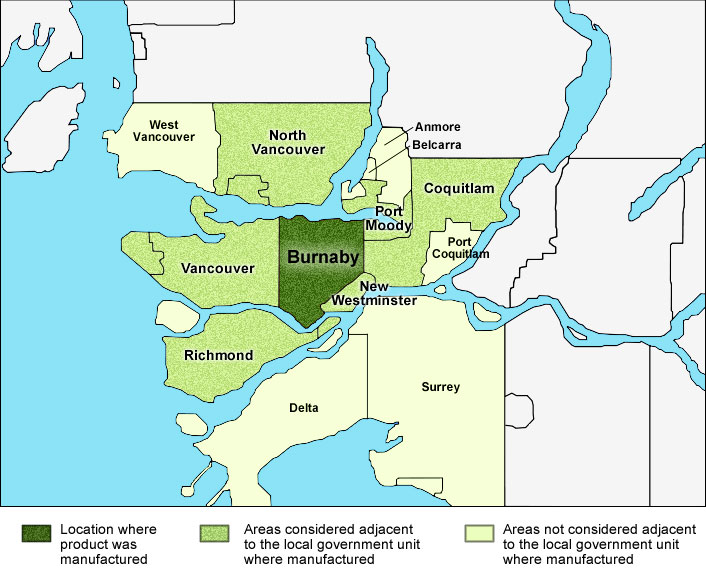
Many markets have strict regulations around what language(s) your labelling and packaging are in. For example, in Canada, unless you are selling only within a limited area considered adjacent to the municipality where the product was manufactured, you are required by the Canadian Food Inspection Agency (CFIA) to use both English and French. Here are some of the CFIA requirements for how each language is used and displayed. Even with inter-provincial trade, labelling and packing requirements may vary depending on the province.

When entering a new market such as the United States, you may not be required to remove the French from your labels, but it will stand out. That’s because only 0.003% of the population speaks the language. If you’ve ever come across American products such as chocolate bars at gas stations or convenience stores, you’ll notice that they immediately pop out due to the differences in design, and lack of French. In markets where there is a strong ‘buy local’ or ‘buy domestic’ mentality, not blending in with local branding and labelling could potentially hurt sales.

There may also be differing regulations with respect to sizing, spacing, and placement of specific features. As a result, it’s generally not advisable to use your Canadian labels in the US, and vice-versa. Doing research on your target market will help you identify its language and labelling requirements. 

Website and Customer Service Considerations

Another factor to consider isn’t only your packaging, but also your website and customer service resources. Ensure that your website and appropriate staff have the language skills required for those markets. While English may be the dominant language of business globally, using the local market’s language will make it easier to build business relationships and provide adequate support for consumers.

A common workaround for smaller operations, or those with a diverse market base, is to contract out the development of a multi-lingual, or language-specific website. You can use in-market resources such as agents to conduct business operations on your behalf, in the local language. One resource that can further assist and bolster the work of in-market partners is Global Affairs Canada’s Trade Commissioner Service. They can assist export-ready companies with participation at trade shows, provide key contacts, and help you host and facilitate meetings. Another great resource is Trade and Invest BC, which can connect you with British Columbia’s Trade Representatives in markets around the world.

Languages are important. It is key for your international success that your message doesn’t get lost in translation! We always recommend tailoring your marketing to your audience. From packaging and labelling requirements to translating your website and customer service, there is a lot to think about when entering a new market. 

Learn More

Need help preparing to export your product or service? Reach out to us and talk to an Export Advisor today about how the Export Navigator program can assist you on your exporting journey. From accessing resources to receiving expert guidance, Export Navigator can help you reach your export goals.

Primary Research for Exporters

Knowing your customers on a deeper level allows you to make better informed business decisions. You’ll be able to tailor your marketing, product development, or services in a way that attracts high value leads and customers. 

Of course, it’s impossible to talk to every single person in your target market to learn what motivates them as consumers. However, you can utilize primary research, the component of market research that involves gathering data and information directly from real people and experiences. While any business might conduct primary research, it’s especially useful for exporters. The information you collect from primary research is a significant factor in making your final decision on your target market, and how to effectively market your business there. In this blog, we’ll cover ways to do primary research, and how it relates to making buyer personas.

You’re likely familiar with doing research online, or secondary research. You may find that secondary research can’t always answer all the questions you have. To fill in knowledge gaps, primary research will help validify your online findings or bring new insights. 

The difference between secondary and primary research is simple: secondary research is a prerequisite to primary research, not a replacement. Both are equally important for a thorough understanding of new markets! Creating a customer (or buyer) persona is a great way for exporters to demystify their target market in terms of knowing who they’re selling to. 

Primary research methods

Data collected from primary research often falls into one of two categories – exploratory and specific. Exploratory information is open-ended, general, and often has few restrictions. Specific information is more intentional about answering a question or solving a problem. Here are a few different methods that cover both ends of the spectrum:

  • Interviews

Interviews are suitable for getting exploratory information from a small number of people, either one-on-one, or in a small group. Whether it’s formal or informal is up to you. There are usually little to no limits imposed on the conversation, so expect to cover many topics. Interviewing a subject matter expert is immensely valuable for gaining an expert opinion on your industry, target market, and so on. 

  • Focus groups

Focus groups are a type of group interview. What sets it apart from a regular interview is the type of participants selected. In focus groups, you would specifically choose demographically similar people to interview. As an exporter, one example of a focus group is gathering a small selection of consumers aged 18-24 from your target market. You could also group similar buyer personas together and find participants that match your descriptions of potential customers. 

  • Surveys 

Surveys are less flexible than interviews because there are typically more people involved. It is a more structured method, with predetermined questions that you can’t change on the fly. A lot of thought goes into designing a survey, with the goal of getting precise answers. This method is useful for gaining specific information and insight into what a larger population thinks. You can administer surveys online, with sites such as SurveyMonkey, Google Forms, or Jotform

  • Observations

Observations are for when you want a less biased approach to the research question you’re trying to answer. Rather than interviewing someone for their point of view, the observation method involves taking organized notes about what you observe. For example, you might travel to the target market and observe the attitudes or preferences of your target market. If you were at a trade show, a question you could answer through observation is what are the most common marketing practices there. This method is open-ended and is suitable for collecting exploratory information. 

  • Analysis 

No matter what method you use to collect your data, you’ll need to analyze the responses. Analysis is organizing your data according to criteria you develop, and using it to discover patterns that answer your research question. It can be simple, like recording your observations and grouping common ones together, then drawing conclusions from your notes. Or, you can use online tools with sophisticated data analysis techniques. From word clouds to graphs, there are many ways to draw definitive conclusions from your research. 

Creating your buyer persona

Now that you have a quick overview of what primary research entails, you can use these methods in building a buyer persona. Just like how authors create a character, marketers do the same thing making buyer personas. According to hubspot, the definition of a buyer persona is a “semi-fictional representation of your ideal customers based on data and research.” The good news is, if you’ve done your primary research then you’re already halfway through creating your first persona! 

The objective of having a customer persona is twofold – figuring out who your ideal customer in an unfamiliar market is and how to best cater to them. Doing primary research first allows you to learn what customers and prospects like about your business. This will help you put together a customer persona. 

Here are a few key points to look for when making your customer persona(s):

  • Basic demographic information (Age, gender, occupation, cultural background, family status, etc.)
  • Motivations – What drives this person to make decisions, especially when it comes to buying different items or services? Does it have to do with fulfillment, social status, love, or basic survival
  • Challenges – How can your product or service make this person’s life easier?
  • Lifestyle – How does this person generally live? What does the lifestyle of your ideal customer look like? 
  • Job – This is briefly covered in the demographics section, but it’s worth going in-depth on your buyer persona’s job. What is their job title and role? What skills or education is required? 
  • Shopping preferences – How does this person like to shop? Do they prefer to shop online or go in person? How do they research new vendors or products to try? 

Personas are often used for creating persona-specific content. Examples include using the social media platforms your persona spends the most time on, and considering the social causes your persona stands for. For example, if you were to partner with a company or influencer, make sure it’s one that appeals to and has compatible values with your persona.

Next steps

Not sure if your market research is going in the right direction? Export Navigator can help. Our experienced export advisors can walk you through the export process, including the fundamentals of market research. Talk to an advisor today to get started. 

Secondary Research for Exporters

Your target market can make or break your exporting success. Market research can ensure you choose the right target market for your business. In our blog, “How to Choose a Target Market,” we went over the basics of export market identification and different types of research. Since market research is such a vast topic, this blog post will revisit some of the concepts we previously introduced in greater detail. 

Drawing on insights from our past webinar, “Market Research for Exporters” presented by Greg Henderson of Exportspark, we’ll be delving into secondary research. 

Why spend time on market research?

Market research can require a significant amount of time, energy, and resources. However, the hardest part is often just getting started – once you know how and where to research, you’ll be set! Part of market research is assessing the risk versus reward of exporting for your business. If your business isn’t prepared properly, the failure rate is high. That being said, the opposite is also true. With proper preparation, you could open many doors for your business through exporting. 

We’ll take you through one way of doing secondary research that considers best practices, how to find the most accurate sources of data, and how to rank your findings. 

Secondary research methods

As a refresher from our last blog post, secondary research is when you use existing research to form your own conclusions. We’ll be focusing on online research as that is one of the most common and accessible methods of research. 

Don’t forget to check online resources for accurate and up-to-date information. When in doubt, try these trustworthy sources to verify your research: 

  • Associations 

Associations often conduct their own research so they’re a go-to resource for any exporter. Your sector may have an association, such as BC Wood or BC Food and Beverage, that has a vast library of industry-specific export resources. Keep an eye out for webinars and other events hosted by associations to brush up on industry knowledge.

Wikipedia is a free online encyclopedia that is updated regularly. It is generally a reliable source that utilizes a community of fact checkers and a wiki-based editing system. 

  • Agencies

Agencies and programs like Export Navigator, Trade & Invest BC or the Trade Commissioner Service are helpful for getting one-on-one support and have their own resources on exporting. Export Navigator hosts webinars, offers free e-courses, and maintains a resource directory on everything export-related. 

Now that you know where to do secondary research, here are a few best practices that will yield the most accurate results:

  • Double check and verify info for accuracy

Confirm your findings by cross-referencing your data with other sources. 

  • Try to avoid data that is more than 4 years old

Data is constantly changing, so be mindful of how dated your resources are. 

  • Focus on data that aligns with your unique value

Be intentional in the data you collect. Through your research, you should know whether your unique selling point will translate in other markets.

Ease of Doing Business Analysis 

In your research, you might have come across the ease of doing business index. The popular, but controversial, index from the World Bank provides a benchmark of how every nation ranks in terms of its regulations on businesses. It measures how simple regulations for businesses are, and the strength of property rights. At a glance, the index allows readers to gain a general sense of how easy it is to enter a market. 

In theory, this tool is useful, but it’s not without its flaws. There are a number of variables that the index doesn’t take into account, such as a country’s proximity to large markets, quality of infrastructure, inflation, or crime. Furthermore, the report has been recently discontinued in 2021 because of data irregularities and ethical concerns surrounding the inflating of certain country’s rankings. 

Trade performance indicators are extremely handy because it can give you a better idea of what doing business in any market is like. Luckily, there are other indicators available for market research. To find reliable ranking information of different markets, here are some alternative existing indicators you can refer to: 

Wondering what the density of new businesses in your target market is? The Entrepreneurship Database project collects data on registered firms from 2006 to 2020, focusing on the following three variables: the number of new firms, total number of firms and number of closed firms.

The LPI is an interactive benchmarking tool. It lets you see the performance of each country’s challenges and opportunities on trade logistics, such as labor skills/shortages, environmentally-friendly logistics, and resilience to cyber threats. 

Trade map provides a wide range of indicators on exporting. They have everything from export performance to international demands, and even alternative markets.

PESTEL Analysis

After gathering all your data, you’re ready to do a PESTEL analysis. A PESTEL (sometimes referred to as PEST) analysis helps you rank your markets in order of viability, risk levels and ease of doing business. The PESTEL analysis stands for the following categories:

  • Political stability

Is your target market politically stable? Part of a stable government includes being proactive in economic affairs, such as exports, imports, sales, and so on. A stable government also means adequate support for exports and a reliable market for your business to thrive in. 

  • Economic strength

Will the average customer in your target market be able to afford your products? Canadian goods are typically considered premium quality abroad. Ideally, the average consumer in your target market has more than enough disposable income to spend on imported goods and services. 

  • Social factors

Social factors can paint a detailed picture of your ideal customer. Cultural norms, working hours, shopping habits, culture, and religion are just a few of the social factors that make up your customer persona. 

  • Technology adoption

These days, technology adoption permeates all aspects of business. It’s important to know if your target market is on par with your business’ technological needs. For instance, software or ecommerce businesses won’t fare well in a region with poor Internet connectivity. Or, if your marketing is heavily dependent on social media, look into what social media platforms are most popular in your new market.

  • Environment

If your product or service is known for being sustainable and environmentally-friendly, you should target markets that have a reputation for being green. 

  • Legal framework  

Intellectual property (IP) is a vast topic – some common IP types are copyrights, patents, trademarks, and trade secrets. However, not all countries recognize the same IP types which could pose a risk to your business. That’s why familiarizing yourself with the legal framework of your target market is highly recommended.

Market research consists of frameworks and criteria that you can use to map out your ideal market or customer. In this case, the goal of doing secondary research is to come up with your top few markets (ideally two or three) you’d like to enter. Next, you’ll need to engage in primary research to validate those markets – a critical step. 

Stay tuned for our next blog as we take a deep dive into primary research, where we’ll talk about building your customer persona and basic primary research methods. 

Learn more 

Export Navigator is here to guide you through the fundamentals of everything export-related. We regularly host webinars on a wide range of exporting topics. Check out our Export Education page for upcoming events and sign up for our newsletter so you never miss them!