
If done successfully, exporting is extremely rewarding. It can result in higher profits, economies of scale, and innovation. However, the reality is exporting does not come without its fair share of risks and challenges.
You may already know about how exporting out of British Columbia (B.C.) is especially advantageous. But before you go all in, it is essential to evaluate your business’s export readiness. Setting realistic goals and expectations for your business is key to avoiding costly mistakes.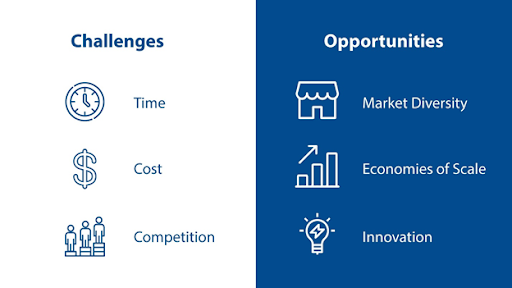
Even if you aren’t ready to export now, you can find out what you need to work on for the future! Export Navigator offers an excellent free e-course, Export Essentials, that covers all the basic topics you’ll need to know.
With that said, let’s jump into the opportunities and challenges that come with exporting.
Opportunities of Exporting
Market Diversity
B.C. is home to an array of unique and reputable businesses. The size of its market, however, is limited. By exporting out of B.C., you open yourself to many new opportunities across Canada and abroad. As a result, your business will become less dependent on the local market. You can also target global buyers online with a well-planned website and gain more prospective international customers. Entering more markets also allows you to make the most of the free trade agreements we have with other countries. The more diverse your market is, the more competitive your company becomes – both domestically and globally.
Economies of Scale
This term may be unfamiliar to you, but its meaning is relatively simple. Basically, it is possible to decrease production costs if you scale up production units.
Economies of scale are seen as a sign of growth. Exporting can make it easier to achieve economies of scale because you’ll likely face increased demand for your product over time. While it might not happen overnight, exporting can result in more cost-effective production.
Innovation
The global marketplace isn’t just for goods or services, but also for the exchange of ideas.
One major benefit of exporting is the number of creative opportunities you’ll have. Introducing your product to a new market stimulates competition, which leads to new ideas. For example, you might discover another way to improve your product or expand your product line.
Exporting requires you to think outside the box, but this doesn’t only apply to products. It enables you to also develop more streamlined business processes or try out new marketing strategies. Because exporting demands a bigger and better version of your business, it is an invaluable opportunity for professional growth.
Challenges of exporting
As with any worthwhile endeavor, there are a number of risks and challenges that you need to consider before committing. It is important for you and your team to be fully aware of the time, money, and competition that’s involved in exporting.
Below are three major challenges of exporting, and what to expect for each.
Time
Exporting is an ongoing time commitment. Extensive research in different areas is required for making sure the export process goes smoothly. Some of the work involved is short-term, while others, like maintaining business relationships, are long-term commitments. Here are some of the areas you’ll need to spend time on researching:
- Rules and regulations in your target market
- Building and maintaining relationships with your new business partners
- Labelling and documentation required in your new market
- Transportation needs for your product, and related costs
- Paperwork
- Cultural differences in your new market and how they might affect the way you do business
Did you know? If you export food, pharmaceutical, or cosmetic products to the United States, it must first be recognized by the United States Food and Drug Administration (FDA).
Costs
Exporting is an investment that can be expensive. Make sure you are financially capable of funding your export-related activities and look for funding that your business is eligible for. There are also government grants, loans, and guarantees available if you need support.
Hiring
You may find yourself needing some extra hands during some point in your export journey. Hiring more employees is one possible expense you could incur, especially as demand for your products increases. You want to make sure you can still respond quickly and effectively to customer inquiries and orders. However, that isn’t to say small teams can’t export – even a one-person business can export successfully!
Production
Higher demand means you should account for higher production costs. On top of making more units of your product, the number of associated costs will increase as well. You might need to spend on modified packaging and marketing materials in a new language, for instance.
Networking
Meeting potential buyers in a new market is a crucial step in exporting. Without having the right connections, it’d be difficult to establish your business’s presence in that new market. One way to meet potential buyers is through attending virtual or in-person trade shows, which can get pricey from registration fees and travel.
Market research
Before deciding on which market to enter, you have to see whether your business would be a good fit for it. You’ll gain insight on who your competitors are, the level of demand for your product, and your projected performance in that market. You will also need to know the profile of your average customer, the size of your market, and so on. That’s where market research comes in. For small businesses, this work is often outsourced to other companies, another expense to consider before you start exporting.
Competition
You probably already have a clear idea of who your competitors are in your local market. When exporting, you’ll also be dealing with a much wider pool of competitors in your new market. On top of that, you will need to meet the expectations of your new customers.
Facing domestic and foreign competition is both a challenge and an opportunity. As mentioned earlier, competition often leads to developing innovative methods of making your product or business stand out. It is also a challenge because this could require more precious time and resources.
Getting support
Business owners may feel overwhelmed after learning about the complexity of the export process. It is common for these feelings to arise, especially as a first-timer with no outside help.
Export Navigator aims to make exporting as approachable as possible for both newbies and those who already have some experience. No matter your exporting level, the program helps entrepreneurs save money, time, as well as by giving them a competitive edge. Talk to an Export Advisor today and learn about ways Export Navigator can support you and your business.


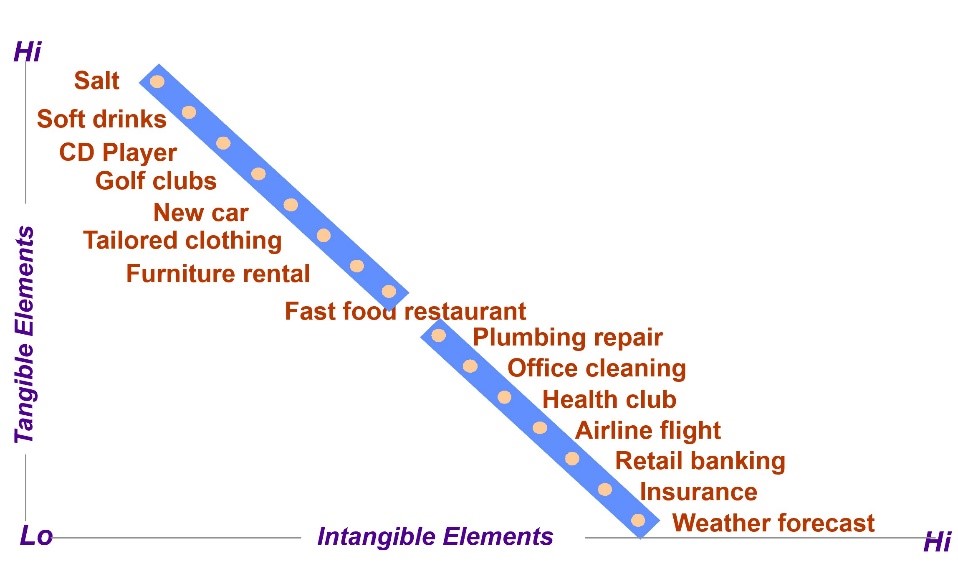 At this point, we need to make an important distinction between goods and services. We sometimes hear that “In today’s business world, every firm is a service firm!” We know all businesses that provide customer service will be judged by the quality of their customer service. But here is the distinction: customer service, or after-sales service, are not the same as the service products created by services businesses.